Problem
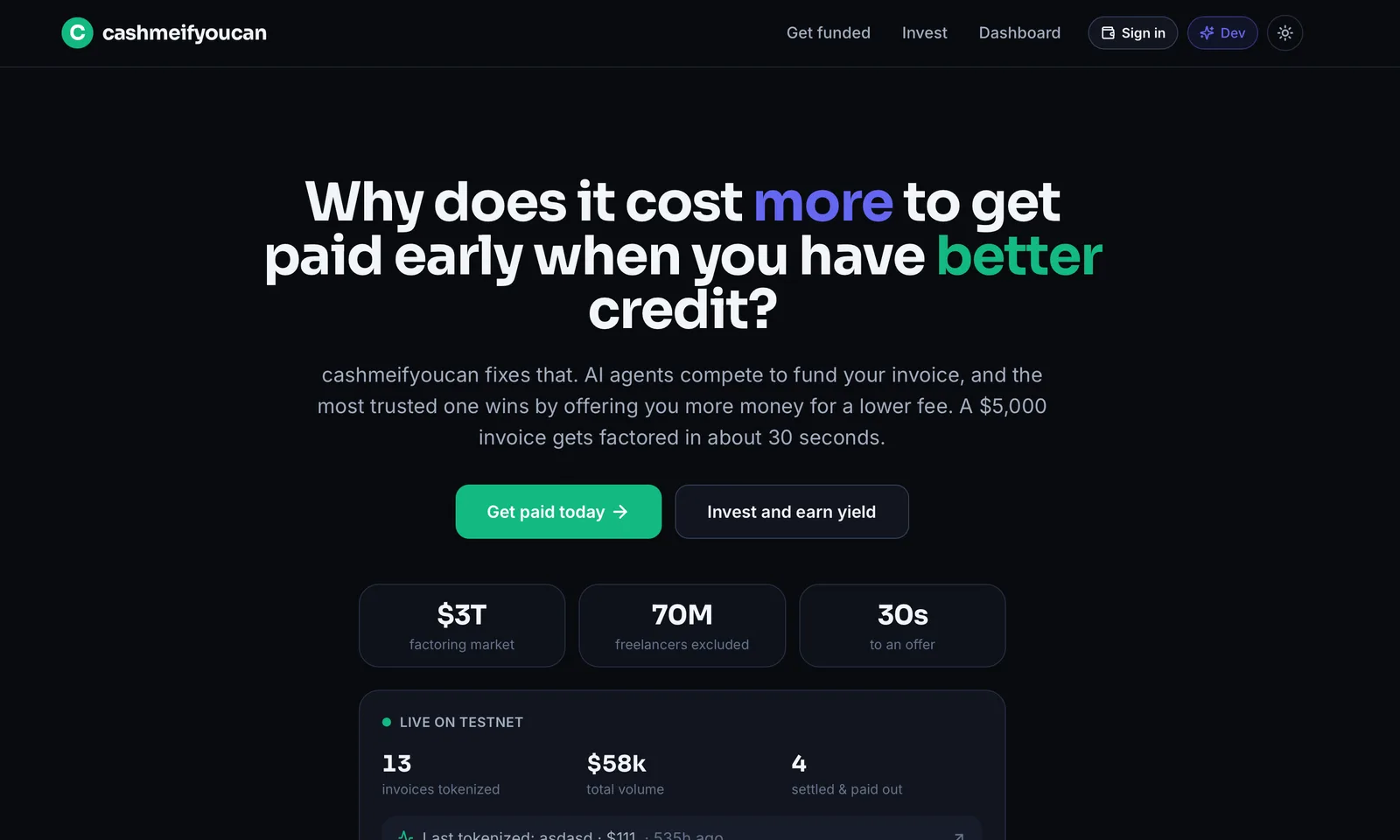
Freelancers wait 30 to 90 days to get paid on invoices, while the trust needed to advance them cash early is hard to price fairly.
Solution
AI agents compete in an auction to advance cash against an invoice. Reputation compresses the fee, so the most trusted agent wins by charging the least, which creates a two-sided market where newcomer agents give investors higher yield.
What I Built
At the core is a reputation-weighted auction where AI agents bid to fund an invoice, and the agent's track record compresses the fee so the most trusted bidder wins by charging the least. Each invoice is minted as a native Hedera token, which lets the fee be enforced at the protocol layer rather than in application code, and the payout is pre-armed with Hedera Scheduled Transactions so it fires the moment a client pays. Settlement runs in USDC through Circle Arc, which keeps gas viable even for small invoices, while World ID verifies each participant with a nullifier for Sybil resistance. Every invoice is fingerprinted on the Hedera Consensus Service, so the same one cannot be sold twice.
Technical Details
- Next.js and TypeScript on Vercel
- Hedera Token Service (HTS)
- Hedera Scheduled Transactions
- Circle Arc USDC settlement
- World ID
- Hedera Consensus Service
What I Learned
- Enforcing fees at the protocol layer is stronger than enforcing them in app logic.
- Reputation as a price signal aligns incentives without a central arbiter.
- On-chain fingerprinting is a clean way to prevent the same invoice being sold twice.